A Passion for Flying: 8,000 hours of RAF Flying by Tom Eeles
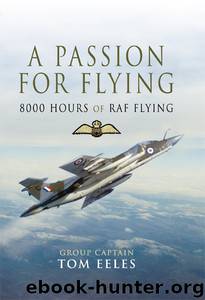
Author:Tom Eeles
Language: eng
Format: epub
Tags: Bisac Code 1: HIS027140; HISTORY / Military / Aviation
ISBN: 9781844688562
Publisher: Pen and Sword
Published: 2008-07-15T04:00:00+00:00
RAF Honington was a typical pre-war bomber base set in the Suffolk countryside. It had been closed for a few years before reopening for the RAF’s Buccaneer squadrons in 1969. There was only one squadron resident, 12 Squadron, so it was a bit of a sleepy hollow compared with Lossiemouth. Setting up 237 OCU was quite a challenge. I recall having to visit the scrap heap at the recently closed down RAF Stradishall to recover briefing boards for our briefing rooms as Honington seemed unable to provide any. We opened for business in June 1971 and the pattern of activity was almost identical to what had taken place at Lossiemouth. Unfortunately there was no flight simulator at Honington so many journeys were made up north to use the simulator that was still in use at Lossiemouth.
Our early students were a complete mixture, ranging from first tourists with no previous experience through to our future Station Commander and even the Air Officer Commanding. The RAF looked on the Buccaneer as a sort of mini V bomber and much to our horror tried to make us operate it in a similar fashion to a V bomber. Not surprisingly we resisted as we saw the Buccaneer as more of a larger Hunter fighter-bomber. Luckily for us, our new Station Commander, Group Captain Peter Bairsto, known to all as ‘the Bear’, agreed with the maxi Hunter philosophy and fought hard for this in the corridors of power. The OCU was commanded by an extremely handsome and upper class Wing Commander, Anthony Fraser; his senior flight commander and Chief Flying Instructor (CFI), Squadron Leader David Mulinder, was a man of great character and wit. We soon settled into the business of training RAF aircrew on the Buccaneer and it was not long before some RN aircrew started to appear on the instructional staff.
One night one of the first tour student navigators, David Herriot, and I were programmed to fly in a three-aircraft formation; we were to be the lead aircraft. Unusually it was a busy night at Honington, with a number of visiting aircraft including a twin-engined Andover passenger aircraft that was bringing in a load of visiting VIPs. It was also a very dark night without moonlight or stars.
All went well with the sortie up to the point when I lined up on the runway as a three-aircraft formation for a 30-second stream take-off. I should point out that the Buccaneer, because of its naval ancestory, was not at that time equipped with a landing lamp, as they are superfluous on aircraft carriers. It was therefore not possible to see anything in the darkness ahead apart from the runway edge lighting.
Brakes off, full power and off we went. Initially all seemed OK. The airspeed indicator began to give readings but, at about 100 knots, the aircraft rapidly decelerated and came to a halt. I still had full power applied and thought at first I had inadvertently put the arrestor hook down but, no, the selector was in the up position and there was no green light showing it to be down.
Download
This site does not store any files on its server. We only index and link to content provided by other sites. Please contact the content providers to delete copyright contents if any and email us, we'll remove relevant links or contents immediately.
| Africa | Americas |
| Arctic & Antarctica | Asia |
| Australia & Oceania | Europe |
| Middle East | Russia |
| United States | World |
| Ancient Civilizations | Military |
| Historical Study & Educational Resources |
The Radium Girls by Kate Moore(12097)
100 Deadly Skills by Clint Emerson(4975)
Rise and Kill First by Ronen Bergman(4842)
The Templars by Dan Jones(4741)
The Doomsday Machine by Daniel Ellsberg(4559)
The Rape of Nanking by Iris Chang(4269)
Killing England by Bill O'Reilly(4046)
Stalin by Stephen Kotkin(4010)
Hitler in Los Angeles by Steven J. Ross(3983)
12 Strong by Doug Stanton(3584)
Hitler's Monsters by Eric Kurlander(3389)
The Code Book by Simon Singh(3257)
Blood and Sand by Alex Von Tunzelmann(3246)
Darkest Hour by Anthony McCarten(3165)
The Art of War Visualized by Jessica Hagy(3050)
Hitler's Flying Saucers: A Guide to German Flying Discs of the Second World War by Stevens Henry(2779)
Babylon's Ark by Lawrence Anthony(2723)
Tobruk by Peter Fitzsimons(2566)
The Second World Wars by Victor Davis Hanson(2555)
